Friday, February 5, 2010

Spotlight on American Kestrels

The American Kestrel (Falco sparvericus) is North American's smallest falcon. As in most other species of raptors, the female kestrel is larger than the male-- but unlike most other raptor species, American Kestrels are sexually dimorphic in colour, which means that the males and the females have very different markings. These quick little birds were once known colloquially as 'sparrow-hawks', and although they are not a hawk, they do prey on birds such as sparrows, finches, warblers, and even doves! They also hunt large insects and small rodents. They are the only North American falcon that often 'hovers' in the air while hunting.

The Mountsberg Raptor Centre is proud to announce a new resident American Kestrel-- a young male. Male kestrels make up for their small stature with their excellent maneuverability and brightly coloured plumage. With a blue cap and wings, this as-of-yet-nameless male cuts a dashing figure at only nine months of age. In captivity, kestrels can live as long as 15 years. The new male (picture at left) joins current Mountsberg resident kestrels Conan, Lizzie (pictured below), and Katy. Keep an eye on our Facebook Page to receive future updates on this little boy and all the other Raptor Centre residents!

Ontario has four native species of falcons. In order of increasing size, these species are the American Kestrel, the Merlin (Falco columbarius), the Peregrine Falcon (Falco peregrinus), and the Gyrfalcon (Falco rusticolus). Of the four, the American Kestrel is the most common species, and is relatively easy to spot in Southern Ontario. American Kestrels often perch on power-lines, telephone wires, and roadway signage. To see one, keep your eyes open for a robin-sized bird that repeatedly bobs its head and flicks its tail while perched-- chances are, it's a kestrel.

The next time you visit the Raptor Centre, be sure not to miss this diminutive but unique bird of prey. See you on the trails!

Wednesday, January 20, 2010

Owl Prowls!

Owls have captured human imagination for thousands of years. They are often depicted in myth and legend, playing both positive and negative roles depending on the originating culture. Athena, the ancient Greek goddess of wisdom, is often described with an owl in attendance; the Greeks considered owls (particularly the Little Owl, who gains its latin name, Athene noctua, from the goddess) to be sacred. But while owls have been considered symbols of wisdom and intelligence in some areas, they have also been considered stupid, foolish, or symbols of madness. In many cultures, owls are traditionally considered an ill omen, or even a sign of impending death.

How can one creature inspire so many-- and such paradoxical-- interpretations? Perhaps it is due to their nocturnal nature, their excellent camouflage, their haunting calls. Maybe it is because of their silent flight, their fixed wide-eyed stare, or their measured movements. All of these characteristics, and likely many more, may contribute to the feelings of fascination and curiousity which owls inspire.

Learning about these fascinating creatures is easier than you may think! There are over two hundred species of owls living world-wide, with an incredible variety of shapes, sizes, and features. The smallest owl on the planet, the Elf Owl is not much larger than a house sparrow-- but the largest, the Eurasian Eagle-owl can weigh up to 10 lbs and is able to prey on young deer and sheep!

Ontario has eleven native owl species, ranging in size from the tiny Northern Saw-whet Owl to the powerful Snowy Owl. The Mountsberg Raptor Centre currently provides a home for representatives of six of our native species-- including the Barn Owl, one of Ontario's Species at Risk.

Late winter is one of the best times of the year to seek out owls in the wild, and it's also the best time of year to take part in an Owl Prowl! The Mountsberg Raptor Centre is proud to host our upcoming Owl Prowl programs at the park. These programs are a wonderful opportunity to learn more about Ontario's native owl species-- including habitats, calls, and behaviour-- as well as meet some of our resident owls up close and 'nose-to-beak'! The adult program takes place on Friday, January 29th, while family night is Saturday, January 30th. Please call the park for program details and registration. It'll be a 'hoot'!

(Photos © 2010 B. R. Murphy - used with permission)

Wednesday, January 6, 2010

New Years Updates and Noah's Story

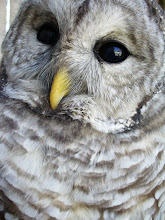
Mountsberg Conservation Area rang in the new year with our New Year's Hoopla event-- and two of the Raptor Centre's resident owls were in attendance! Chomper the great-horned owl met with families out in the barn for an evening chat, while Teddy, one of our barred owls, took part in family photos.

Seventeen different families chose to have a New Years photo taken with Teddy, and the Willis family was kind enough to allow us to share theirs in our blog! We hope that our guests had as much fun attending the Hoopla as we had hosting it, and that everyone enjoyed the opportunity to see two of Ontario's native owl species up close while we rang in 2010.

In other raptor holiday wrap-up news, we are very pleased to announce that Otus, one of Mountsberg's eastern screech-owls, has fully recovered from the illness mentioned in our last update. We are very grateful to the staff of the Avian/Exotics clinic for the excellent care he received at the Ontario Veterinary College. Otus, for his part, was feeling well enough to get into the holiday spirit-- in fact, he was reluctant to get out! Of the tree, that is:


We would also like to share an inspirational story with our readers, and at the same time give our heartfelt thanks to a very dedicated young man. Raptor Centre Resource Interpreter Lara Butt writes:

"In July of 2009, our Raptor Centre was booked to visit four Wellington County Libraries over a three day period. There the families were able to see four different native raptor species up close and learn loads of interesting facts from our resident birds of prey. During our visit to Erin Library, a young, budding raptor enthusiast was 'hatched'!

As caretakers and educators of our 31 non-releasable birds, we encourage people to help in this process through such ways as our 'Adopt-a-Raptor' program or volunteering. Several of our brochures, pamphlets, and Species at Risk posters were passed on to the families after the session and one recipient was an 8-year-old fan, Noah! Captivated by our beautiful birds, Noah studied our Adopt guide and took it upon himself to raid his piggy bank for coins and during a family get together managed to collect almost $25 towards the 10 birds listed in the guide.

We were contacted by his family to arrange a time for Noah to present us with his fantastic donation and visit our birds up close and personal! As a token of our appreciation, Noah was given the opportunity to hold one of our screech owls, Echo, perched on his hand.

Following this, Noah continued to email us with his attempts to organize a fundraiser at his school. He waited anxiously for a response from the school council but unfortunately this was not an option at that time. Noah, only motivated further to find another opportunity to raise funds, asked his Mother if he could celebrate his 9th birthday party at Mountsberg. Instead of his invited guests bringing gifts, Noah suggested a donation towards our 'Adopt-a-Raptor' program. With four friends attending he received $100.00! Unselfishly, he also collected his own money to create small amounts for the 21 of our resident raptors. In total Noah has generously donated to 28 individual birds. His collective sum came to $149.75!! With this amazing donation, Noah has enabled us to do such things as purchase food and provide new building and housing material for several birds.

The Raptor Centre staff are very grateful for the tremendously thoughtful ideas and initiatives that such a young, keen friend like Noah has contributed! Thank you so much, Noah, for your efforts and passion for wildlife, and keep up the great work!"

Individuals like Noah make it possible to maintain and improve on the excellent care and housing we provide for the Raptor Centre's non-releasable birds of prey. His story is an inspiration to all of us here at Mountsberg, and we hope that all who read it will be encouraged towards an interest in Ontario's native raptors.

See you on the trails!

Wednesday, December 23, 2009

Holiday Tidings and Updates from the Raptor Centre!

With the holidays already upon us, Mountsberg Conservation Area has been bustling with activity! Santa and Mrs. Claus will soon be waving their goodbyes to the last of our visiting families out at Mountsberg's Christmas Town, and just in time to gear up for their big night. Don't worry, though-- there will still be lots of things to do at the park after Christmas! The birds of prey in particular are looking forward to making an appearance at the New Years Hoopla event, which is sure to be a hit; it includes a winter wagon ride, dinner, crafts, a night hike, a barn visit, a bonfire, and more! Call the park to reserve your spot, as we are filling up quickly!


If you visit the park during the holidays, our seasonal wagon/sleigh rides will take place daily at 1pm and 3pm for $2.00 per person, which takes you on a 45-minute excursion along part of the beautiful Lakeshore Lookout Trail. Our bird of prey shows will run daily at 12pm and 2pm in the Raptor Centre theatre-- be sure to bring your camera!

The Raptor Centre Staff have been busily getting the birds ready for winter; as we mentioned in our last entry, the onset of the winter cold means that our temperature-sensitive raptors are moved into their winter housing and may no longer be on public display. If your favourite bird is off display, feel free to ask the Raptor Centre staff for an update when you visit!


Unfortunately, not all of our holiday news is good news-- Otus, one of our two grey-phase Eastern Screech-owls, has been under the weather lately. Eastern Screech-owls are one of Ontario's most common species of owl, and they are also the second smallest owl (after the Northern Saw-whet Owl) that lives within the province. Just like humans, birds of prey can suffer from illnesses-- and just like humans, a sick raptor goes to visit the doctor! In this case, Otus was taken to the Ontario Veterinary College, and the trip to the veterinarian revealed that he was fighting off an infection of the central nervous system. Thanks to the excellent medical care received at the Ontario Veterinary College, Otus is well on his way to recovery and seems to be enjoying the extra holiday attention.

In other raptor news, Pawgwashiing the bald eagle is still doing very well during her training period, although she has developed into quite the picky eater! While most raptors are happy to eat a variety of prey items, this youngster has decided that rabbit and rainbow trout are her favourites-- and that she would really rather not eat anything else. Luckily, a very kind gentleman who visits Mountsberg regularly has been keeping Pawgwa stocked up with trout... but we have it on good authority that our male bald eagles, Cornelius and Phoenix, may be getting jealous!

We are happy to report that Pittsburgh Pete the peregrine falcon is also doing quite well. Mountsberg Raptor Centre would like to thank the local Falcon Watchers who have visited the park since Pete's arrival, and who have been generous enough to share stories and photos of Pete's 2008 season on the Burlington Lift Bridge. We will be sure to continue Pete's story in a future blog entry.

If you are interested in supporting our resident raptors, we invite you to visit the park and pick up an Adopt-a-Raptor brochure. Your donation helps to pay for food, equipment, and veterinary care for non-releasable birds like Otus! Volunteering is also a great way to support the Raptor Centre. We would like to extend our heartfelt thanks to our dedicated and talented volunteers for all their hard work in keeping the Raptor Centre (and the birds) running smoothly. We can't do it without them! If you are interested in volunteering at the Raptor Centre, please contact us for more information, and stay tuned for a future blog entry detailing volunteer experiences at the park.

We hope to see you on the trails-- and have a safe and happy holiday season!

Friday, November 13, 2009

Autumn in the Park


Autumn is already well underway at Mountsberg Conservation Area, and the Raptor Centre is beginning to prepare for the coming winter. At this time of year, park visitors often ask us about how winter affects our resident birds. How do they cope with the cold? Where do they go in the winter? How can they stay warm? The answer to such questions depends on the individual needs of our birds of prey. With over thirty resident raptors currently in the park, there's a lot to keep track of as the weather starts to get colder!

As the temperature drops, the quantity of food our birds require goes up; some of the smaller birds are fed more frequently than they are during the warmer months to keep energy levels high. Migratory species, such as Turkey Vultures, are brought inside during the worst of the cold. Temperature-sensitive species such as Barn Owls also come inside, as does any individual bird with reduced tolerance to the cold. Mountsberg is currently putting the finishing touches on new indoor winter housing with full-spectrum lighting that will help to make the winter months more comfortable for our temperature-sensitive birds. A note to park visitors: while our birds are inside for the winter they are off public display. If you visit the park and don't see your favourite feathered friend, they are probably away for their winter vacation!

Not all of our birds have trouble with the cold. Some species, such as large owls, hawks, and eagles, have thick plumage and are very capable of comfortably surviving a Canadian winter. These birds are monitored daily to ensure they are coping well with temperature changes. Our Snowy Owls definitely enjoy winter, and are often to be found nestled down (and perfectly camouflaged) in a snowbank!

Snow removal during winter is always a challenging chore at the Raptor Centre. Luckily, our staff and our dedicated volunteers are adept with shovels and scrapers, and are ready to brush off perches and shovel pathways first thing in the morning after a heavy snowfall.

Winter is certainly a wonderful opportunity to see Mountsberg's raptors against a different backdrop, but it isn't quite here yet! There are still lots of gorgeous fall days left to enjoy. We are also happy to report that Pawgwashiing Migizi ('Pawgwa') the Bald Eagle and Pittsburgh Pete the Peregrine Falcon are both adapting extremely well to their new homes, and some lucky park visitors may see them out and about during their training!

As always, if you are interested in supporting our non-releasable birds of prey, please come on out to the park and enjoy what Mountsberg Conservation Area has to offer. Consider adopting a Mountsberg raptor as an environmentally-minded Christmas gift; if you adopt a raptor for a year, you will receive a free annual pass to all Conservation Halton parks. What better way to bring the love of nature to a friend or family member! Contact Conservation Halton Foundation Director Brian Hobbs for more information.

See you on the trails!

Thursday, October 22, 2009

Pittsburgh Pete


The Mountsberg Raptor Centre is pleased to announce the arrival of another new member of our education team-- and another Species at Risk ambassador, as well! Pittsburgh Pete is a peregrine falcon who has led a fascinating life since he hatched in 2006 on the Gulf Tower in Pittsburgh, PA. By 2008, Pete had made it up to Burlington, Ontario, where he established a nest on the Lift Bridge. While he and his mate were able to successfully raise a brood of chicks, Pete (also known to falcon watchers as '3/K' because of the identification band on his left leg) was attacked and badly injured by a rival male. Luckily, he recovered from his wounds-- thanks in part to his mate, who brought food to him while he was healing-- and his chicks fledged successfully. You can read more about Pete's family in the October 2008 (PDF - 7.64 MB) issue of The Wood Duck, published by the Hamilton Naturalists' Club.

Unfortunately, Pete's life was not about to get any easier. He was found grounded and unable to fly in November of 2008, and was picked up by Hamilton Animal Control Officer Judy Bailey. Close observation in captivity revealed the problem: Pete was having seizures, but no immediate cause for them was discovered during subsequent visits to a veterinarian. Because of this, Pete was declared non-releasable, and efforts were made to find him a permanent home. That's where Mountsberg enters the story!

Thanks to Judy Bailey's tireless efforts with his training and care, Pittsburgh Pete now has a new life as an educational ambassador; he will help teach the public about the plight of the peregrine falcon, and his story will bring immediacy to the fragile nature of Ontario's Species at Risk. We are proud to be able to provide Pete with a permanent home, and would like to thank everyone who has been involved in his saga: from the dedicated falcon watchers on both sides of the border to the Ontario Ministry of Natural Resources, along with every individual link in the chain which brought this special falcon from the Gulf Tower all the way to the Raptor Centre.

Pete's story, of course, is far from over-- and you and your family can be a part of it! Come out to the park and see the birds at the Raptor Centre. Your visit will help to support Pete and others just like him, and ensure that we can continue to provide non-releasable birds of prey with a safe place to land!

Friday, October 16, 2009

Pawgwashiing Migizi


Mountsberg Raptor Centre is proud to announce the arrival of a new resident-- a six-month-old Bald Eagle! After suffering a permanent wing injury, this juvenile female was initially cared for by members of Pays Plat First Nation, who gave her a traditional name: "Pawgwashiing Migizi", which means 'Eagle of the Shallow Water'. Thanks to many caring individuals, the expertise of both her veterinarian and wildlife rehabilitator, and the support of the Ontario Ministry of Natural Resources, Pawgwashiing was transferred all the way from Thunder Bay to her new permanent home at the Douglas G. Cockburn Centre for Birds of Prey.

Mountsberg is thrilled to be able to provide a home for Pawgwashiing, who will take approximately five years to develop the white head and tail that makes her species so distinctive. While she will not be on public display during her acclimatization and training period, we will post periodic updates and photos to chronicle her progress and development. We have high hopes for her future as an ambassador bird for Ontario's Species at Risk!

Would you like to help permanently non-releasable birds of prey, like Pawgwashiing? Please consider adopting one of our residents! Your generous donation contributes to the care and feeding of these important representatives of our natural world. Pick up your Adopt-a-Raptor brochure on your next visit to the park, or contact Conservation Halton Foundation Director Brian Hobbs for more information.